
Mono-PE vs Mono-PP: How to Choose Recyclable Materials for Liquid Packaging
Choosing between Mono-PE and Mono-PP is not just about picking a recyclable material. For liquid packaging, the real test is whether the pouch can seal well, protect the product, survive filling and transport, and match the recycling stream in your target market.
Mono-PE is often a better fit for flexible, squeezable liquid pouches such as detergent refills, beverage pouches, baby food puree and personal care refills. Mono-PP is usually preferred when the package needs higher heat resistance, better shape retention or retort performance.
As packaging regulations move toward stricter recyclability requirements, including the EU target for all packaging to be recyclable by 2030, brands need to choose materials based on real application needs rather than broad “eco-friendly” claims. The sections below compare Mono-PE and Mono-PP by performance, use case, barrier needs, closures and common selection mistakes.
Quick Answer: Mono-PE or Mono-PP?
Choose Mono-PE when your liquid pouch needs flexibility, strong sealing, puncture resistance and squeeze performance. It is often a good fit for detergent refills, beverage pouches, baby food puree, personal care refills and large-capacity spout pouches.
Choose Mono-PP when your pouch needs better heat resistance, stiffness, shape retention or retort performance. It is often used for hot-fill products, sauces, dairy applications, ready meals and wet pet food packaging.
| Requirement | Better Starting Point |
|---|---|
| Flexible refill pouch | Mono-PE |
| Strong low-temperature sealing | Mono-PE |
| Squeezable spout pouch | Mono-PE |
| Hot-fill liquid packaging | Mono-PP |
| Retort pouch | Mono-PP |
| Better stand-up shape | Mono-PP |
| Large detergent refill | Mono-PE |
| High-temperature food application | Mono-PP |
The final answer should always come from product testing. A pouch that looks recyclable on paper still needs to pass filling, sealing, drop, storage and transport tests.
Why Mono-Material Packaging Matters Now
Recyclable packaging is becoming less about slogans and more about proof. With the EU pushing all packaging toward recyclability by 2030, brands need packaging structures that are easier to collect, sort and recycle after use.
For liquid pouches, this is not simple. Traditional structures often combine PET, nylon, aluminum and PE to get strength, barrier and sealing performance. They protect the product well, but the mixed layers are difficult to separate in recycling.
Mono-PE and Mono-PP help simplify the structure. CEFLEX also favors mono-PE and mono-PP where possible because they can improve sortability, recyclability and recycled material quality.
For brand owners, the value is practical:
- Cleaner recycling direction
- Easier sustainability claims to support
- Better fit with future packaging rules
- Less dependence on hard-to-recycle laminates
- More room to design pouches around PE or PP recycling streams
Still, mono-material does not mean one film works for every liquid product. The pouch must still seal well, resist leakage, protect shelf life and run on the filling line. That is why LD PACK focuses on matching mono PE or mono PP structures with the actual product, filling process, spout design and target market.
What Mono-PE Does Well
Mono-PE liquid packaging is mainly based on polyethylene. Depending on performance needs, it may include LDPE, LLDPE, HDPE, MDOPE or BOPE layers. Its biggest advantage is flexibility. For liquid pouches, this matters more than many people expect. Liquid products create pressure inside the pouch. During filling, shipping and consumer use, the pack may be squeezed, dropped or stacked. Mono-PE can offer good puncture resistance, soft handling and reliable sealing performance.
Mono-PE is often a strong choice for:
- Liquid detergent and cleaning refills
- Shampoo, shower gel and personal care refills
- Juice, smoothies and water pouches
- Baby food and fruit puree
- Flexible sauce pouches
- Large-capacity spout pouches
- Chilled or flexible refill formats
It is also useful when the brand wants a pouch that feels soft and easy to squeeze. For family-size refills or on-the-go liquid packaging, this user experience can be important.
In the US, many plastic bags, wraps and films are not accepted in most curbside programs, but some PE-based flexible packages may qualify for Store Drop-off collection when properly designed and labeled. This is one reason PE remains important for flexible packaging recovery strategies in that market.
Where Mono-PE Needs Care
Mono-PE is not the answer for every liquid pack. If your product needs high-temperature processing, pasteurization or retort sterilization, PE may not provide enough thermal resistance. It can also be softer than PP, so if you need a very crisp stand-up shape, the pouch structure must be carefully engineered.
Print appearance can also require attention. Traditional PET-based laminates are known for excellent print surfaces. Mono-PE structures can achieve strong shelf appeal, but film selection, ink system and converting conditions matter.
What Mono-PP Does Well
Mono-PP liquid packaging is mainly based on polypropylene. It can include BOPP, CPP and specialized PP layers designed for heat resistance, stiffness and sealing performance.
Its biggest strength is temperature performance. If your product needs hot-fill, pasteurization or retort processing, Mono-PP is often the better starting point.
Mono-PP is commonly considered for:
- Retort pouches
- Ready meals
- Wet pet food
- Hot-fill sauces
- Dairy products
- Shelf-stable liquid or semi-liquid food
- Pouches needing better shape retention
LDPACK's recyclable retort pouch uses a PP mono-material structure and is designed to withstand up to 121°C for 30 minutes, making it suitable for pasteurization and high-temperature sterilization applications.
PP also tends to provide better stiffness than PE. If the pouch needs to stand more firmly on shelf or hold a cleaner shape, PP can help.
Where Mono-PP Needs Care
Mono-PP can be less forgiving than PE in some sealing and drop-impact situations. For liquid products, this is not a small issue. A weak seal or poor drop performance can create leakage, returns and retailer complaints.
PP-based pouches should be tested carefully for:
- Seal strength
- Drop resistance
- Cap and spout fitment
- Heat exposure
- Long-term storage
- Filling-line speed
Mono-PP is a strong material direction, but it should be engineered around the actual product and process.
Mono-PE vs Mono-PP: Practical Comparison
| Factor | Mono-PE | Mono-PP | Buyer’s Takeaway |
|---|---|---|---|
| Flexibility | Higher | Medium | PE is better for squeezable pouches |
| Heat resistance | Medium | Higher | PP is better for hot-fill and retort |
| Sealability | Excellent | Good, but process-sensitive | PE often gives a wider sealing window |
| Puncture resistance | Strong | Good | PE works well for heavy liquid refills |
| Shape retention | Softer | Stronger | PP helps shelf stability |
| Transparency | More milky | Often clearer | PP may support better product visibility |
| Low-temperature performance | Better | Lower | PE suits chilled or cold-chain uses |
| Retort use | Limited | Strong | PP is preferred for retort pouches |
| Closure match | PE spout/cap preferred | PP spout/cap preferred | Keep fitments in the same polymer family |
Barrier Layer
Many liquid products need more than basic moisture protection. Juice, dairy, baby food, sauces and some personal care products may need oxygen, aroma or light protection.
This is where barrier design becomes important. EVOH is often used as a thin oxygen barrier layer in PE or PP structures. The key is to use it carefully. Too much barrier material can affect recyclability, while too little can shorten shelf life.
A good recyclable liquid pouch should balance three things:
- Product protection
- Recyclability compatibility
- Commercial processing stability
For buyers, the question should not be “Can we remove all barrier layers?” It should be “What is the minimum effective barrier that protects the product and still supports recyclability?”
Spouts and Caps Can Make or Break the Design
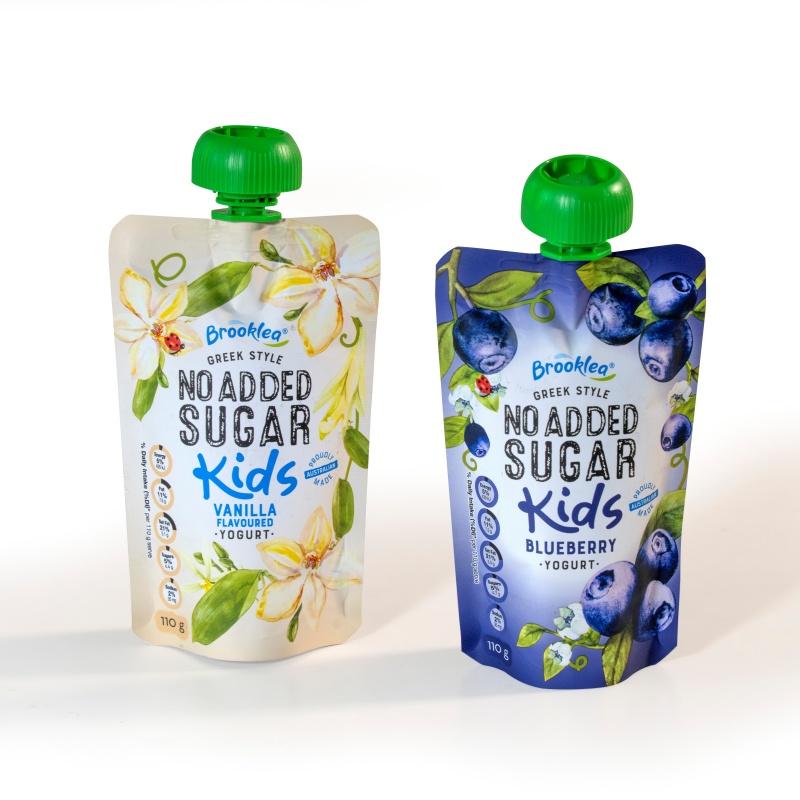
A recyclable pouch is not just film. Spouts, caps, zippers, valves, labels, inks and adhesives all matter. For liquid packaging, spouts and caps are especially important because they can represent a meaningful part of the total pack weight. If the pouch is Mono-PE but the spout is made from an incompatible material, the recycling story becomes weaker.
A cleaner approach is:
- Mono-PE pouch with PE-compatible spout and cap
- Mono-PP pouch with PP-compatible spout and cap
- Minimal incompatible labels, inks and adhesives
- Barrier layers kept within accepted design limits
LDPACK's recyclable spout pouches are available in mono PE, mono PP and mixed polyolefin options, with reclosable cap and spout options made from the same material family.
How to Choose the Right Material
Before asking for a quotation, prepare these five details.
1. Product Type: Is it acidic, oily, dairy-based, alcohol-based, chemical-based or oxygen-sensitive? Product chemistry affects film choice, barrier design and sealant selection.
2. Filling Method: Ambient filling gives more flexibility. Hot-fill and pasteurization need stronger heat resistance. Retort processing usually points toward Mono-PP.
3. Shelf-Life Target: A 30-day refrigerated product and a 12-month shelf-stable product need different barrier structures.
4. Pouch Format: A small spout pouch, flat bottom pouch, double gusset pouch and large refill pouch all place different stress on the material.
5. Target Market: Recyclability depends on local collection and sorting infrastructure. A structure suitable for one market may need adjustment for another.
How LDPACK Supports Recyclable Liquid Packaging Projects
LDPACK develops flexible packaging for liquid products, dairy, sauces, condiments, home care and retort applications. Established in 1990, LD PACK has an annual production capacity of over 25,000 tons and has built dedicated R&D capability for high-barrier, mono-material and recyclable flexible packaging.
LDPACK's recyclable packaging development includes Mono-PE recyclable packaging launched in 2020, MDOPE/PE liquid packaging development in 2022 and Mono-PP structures for retort applications.
For brand owners, this means support can start before production. LDPACK can help evaluate your product, filling method, shelf-life target, pouch format and target market, then recommend a Mono-PE or Mono-PP structure for testing.
Conclusion
Choosing between Mono-PE and Mono-PP comes down to how the pouch will be used. Mono-PE is a strong choice for flexible, squeezable liquid packs that need reliable sealing and puncture resistance. Mono-PP is better for hot-fill, retort, or shape-stable applications. The right recyclable liquid packaging should protect shelf life, match the spout and cap material, run well on your filling line, and fit the recycling stream in your target market. Test the structure before scaling.
FAQ
Q1. Is Mono-PE better than Mono-PP for liquid packaging?
A: Not always. Mono-PE is usually better for flexible, squeezable and strong-sealing pouches. Mono-PP is better for heat resistance, stiffness and retort applications.
Q2. Can Mono-PE be used for hot-fill products?
A: Sometimes, depending on temperature and structure. For higher heat or retort conditions, Mono-PP is usually the safer starting point.
Q3. Is Mono-PP recyclable?
A: Mono-PP can be designed for PP recycling streams, but real recyclability depends on local collection, sorting and processing systems.
Q4. Can recyclable liquid pouches use EVOH?
A: Yes, when designed carefully. EVOH can improve oxygen barrier performance, but the structure should be checked against recyclability guidelines.
Q5. What information should I send to a packaging supplier?
A: Send product type, filling temperature, shelf-life target, pouch size, spout type, storage condition, target market and expected order quantity.